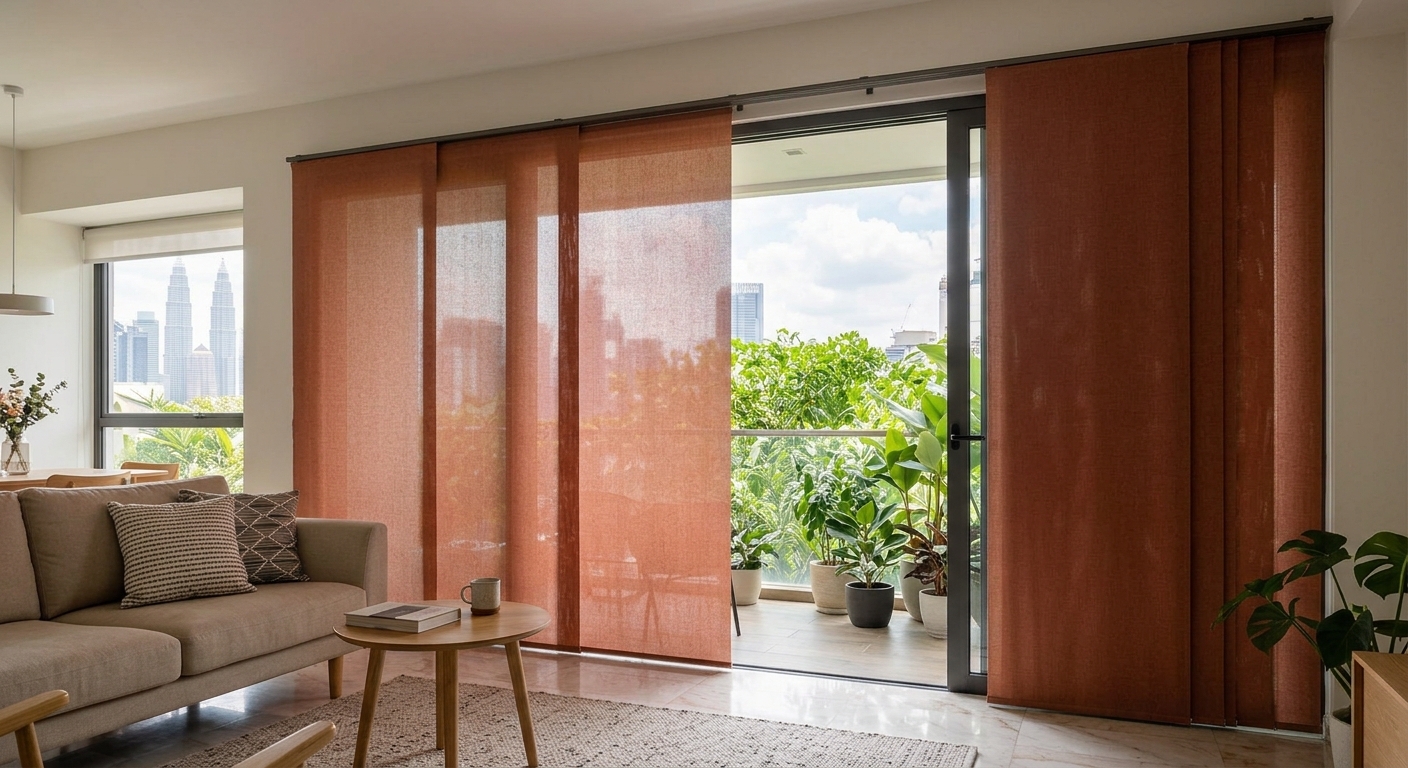
Panel blinds use broad fabric sections that travel sideways along a track. They are worth considering for wide windows and sliding doors, especially if you prefer a flat fabric surface to the folds of a curtain. The important question is whether the panels will move and stack conveniently in your space.
Start with the opening rather than the fabric color. A covering that works well across a fixed window may need a different arrangement beside a door you use throughout the day.
Understand how the panels open
The panels overlap when closed and collect together as they open. The available opening direction and stack arrangement depend on the system, so ask the supplier to show how the proposed setup operates.
Even when open, the panels occupy space. If there is little wall beside the glass, part of the stack may remain in front of the window or doorway. Check the usable opening, not just the overall track width.
Imagine a sliding balcony door with the handle on the side where the panels collect. That layout needs careful planning to avoid making the handle awkward to reach. Bring a photo showing the handle and tell the supplier which door panel you normally use. KL City Curtain’s panel blinds product page introduces this option for wide openings.
Choose fabric for light and privacy
Panel blinds are not all equally private or equally dark. The result depends on the selected fabric, its opacity and the installation. A light-filtering fabric can soften daylight but may not give the level of night-time privacy you expect.
Ask to view samples against a bright background and discuss how the room is lit in the evening. If bedroom darkness is the main concern, ask specifically about light entering at the edges and between components. Do not assume an opaque fabric makes the whole opening light-tight.
Think about care as well. Ask whether the selected fabric can be vacuumed, wiped or cleaned by a specialist. Avoid washing or soaking panels unless the manufacturer’s instructions allow it. Make sure the panels will stay clear of furniture and everyday spills.
Compare panel blinds with curtains and rollers
Curtains offer a softer appearance and can be arranged in separate sheer and heavier layers. They need room for folds and for fabric to collect at the sides. Panel blinds provide a flatter look, but their panel stack must also be allowed for.
Roller blinds retract upwards, which can be helpful where there is limited side space. For a wide opening, ask whether the proposed roller system would use one blind or several, and where any gaps would fall.
There is no single best choice for every sliding door. Compare how much glass remains covered when open, how easily you can reach the door and whether you want layered light control. Ask for a demonstration if you are unfamiliar with the operating system.
Check the layout before ordering
Prepare the opening dimensions, a full-wall photo and the location of nearby handles, switches and furniture. Explain whether the covering is for a fixed window, a frequently used door or a proposed room divider.
KL City Curtain also describes panel blinds as an option for room division. Fabric panels can create visual separation; do not assume they provide sound insulation. Confirm the mounting requirements and suitability of the chosen system for that use.
Review the panel blinds range and use the website contact details to discuss fabric options, measurements and installation. Request a quotation for your actual layout before committing to a configuration.